

Everyone is normal until you get to know them.
David Sim
I’m currently working my way through Gabor Maté’s latest book written with his son, Daniel, The Myth of Normal: Trauma, Illness & Healing in a Toxic Culture.
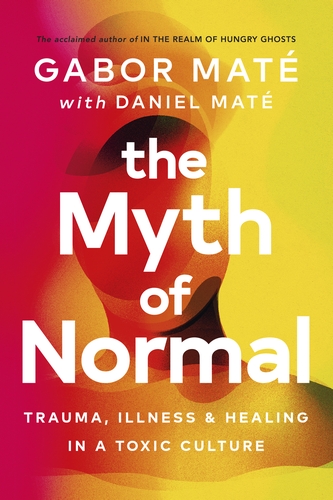
As usual, Maté’s writing is efficient, effective, and to the point. With a equal parts compassion and frustration, the physician and author of In the Realm of Hungry Ghosts, meticulously lays out his argument that there is no such thing as normal in our culture and that there never truly was. Using examples from both his personal story (an unbelieve one in and of itself), Maté systematically breaks down our cultural biases stereotypes and expectations around shame, parenting, racism, mental illness, and even demystifying the belief that addiction is, in fact, not a disease.
While mental ailments certainly exhibit some features of illness–the brain seeming to function like a disordered organ–mainstream psychiatry take the biological emphasis too far, reducing everything mostly to an imbalance of DNA-dictated brain chemicals. (p. 237)
Gabe Mate in The Myth of Normal
The latter is indeed, a powerful disputation that addiction has been incorrectly explained with significant ignorance and misunderstanding among healthcare researchers and professionals. The author of Scattered Minds, a book about attention deficient hyperactivity disorder, pulls no punches while directly addressing diagnostic crisis of young people with ADHD, oppositional defiant disorder (ODD), and immediate folding towards medication as a panacea. The author is clear on where he stands: he not directly against medication, the medical healthcare community’s ongoing failure to ask questions about and explore individual personal history and trauma holds immense culpability.
[D]iagnoses reveal nothing about the underlying events and dynamics that animate the perceptions and experiences in question. They keep our gaze trained on effects and not their myriad causes. (p. 242)
Gabor Mate in The Myth of Normal
Not one to make unfounded generalizations or arguments, the father and son team highly resourced and research travails account for a nearly 150-page bibliography.
Currently, I am nearly two-thirds of the way through The Myth of Normal and hope to offer a deeper reflection early this fall. I cannot recommend enough this timely and relevant resource for those seeking both context and a way forward through the mental health crisis in which western society finds itself. As our family continues to support a family members suffering from deep mental health challenges, this book has afforded as Esther Perel notes “refuge and solace during moments of profound personal [sic] crisis”.
We have all this chronic illness despite the fact that we have the most advanced medicine in the world. Society generates stress and chronic stress makes people ill.
Dr. Gabor Mate – The Myth of Normal
JY
 GETTING CURIOUS